
What causes chest pain during exercise?
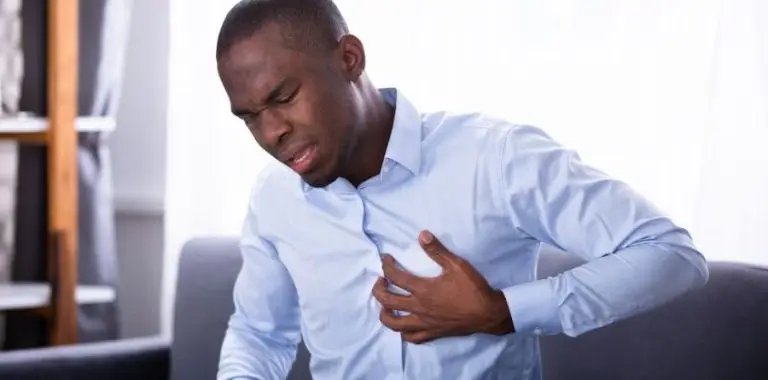
Chest pain during exercise is often caused by angina—a condition where narrowed heart arteries cannot supply enough oxygen-rich blood to the heart muscle during physical exertion. While non-cardiac issues like muscle strain, asthma, or acid reflux can mimic this pain, exertion-triggered chest pressure should always be evaluated by a cardiologist to rule out a blocked artery.
Angina is chest pain or pressure that happens when the heart muscle is not getting enough blood. During exercise, your heart beats faster and needs more oxygen. If an artery is narrowed, blood flow cannot keep up, and the heart signals distress. The most common causes of chest pain during exercise are:
- Coronary Artery Disease (CAD): Coronary artery disease is a buildup of fatty plaque inside the arteries that feed the heart. The plaque restricts blood flow, especially when the heart works hard. Learn more on our coronary artery disease page.
- Exercise-Induced Bronchoconstriction: Exercise-induced bronchoconstriction is a narrowing of the airways triggered by exercise, often called exercise-induced asthma. It causes wheezing, coughing, and chest tightness, usually during or right after a workout.
- Gastroesophageal Reflux Disease (GERD): GERD is a condition in which stomach acid flows back into the food pipe. Bouncing, bending, or exercising soon after eating can trigger a burning feeling that mimics heart pain.
- Costochondritis: Costochondritis is inflammation of the cartilage that connects the ribs to the breastbone. Heavy breathing or lifting can make it worse, and the spot is usually tender when pressed.
- Muscle strain: A pulled chest wall muscle hurts with certain movements, twisting, or deep breaths, and often follows a new or heavy workout.
| Clue | More likely heart-related | More likely another cause |
|---|---|---|
| Feeling | Pressure, squeezing, heaviness | Sharp, stabbing, or burning |
| Trigger | A predictable level of effort | Certain movements, meals, or cold air |
| Relief | Eases within minutes of rest | Lasts hours, or changes with position |
| Pressing on the chest | Does not change the pain | Makes a tender spot hurt more |
| Other symptoms | Shortness of breath, sweating, nausea | Wheezing, sour taste, or soreness |
These clues help, but they cannot rule out heart disease on their own. Our chest pain or heartburn guide explains why antacid relief does not prove the heart is fine.
Alliance Heart & Vascular
Expert heart care that keeps you moving.
Three board-certified cardiologists work as one team to find the cause of your symptoms and build a clear plan for your heart health.
- Dr. Rizwan KhanMD, FACC
- Dr. Muhammad Waheed RajaMD, FACC, FASE
- Dr. Afaq MotiwalaMD, FACC, RPVI
Why does exercise trigger chest pain?
Exercise triggers chest pain because the heart must pump harder and needs more oxygen with every step. A narrowed artery can supply enough blood at rest but not during effort, so the heart muscle runs short and signals distress. Heavy breathing, cold air, and bouncing can also set off lung, reflux, and chest wall pain.
Myocardial ischemia is the medical name for heart muscle that is not getting enough oxygen-rich blood. It is what causes angina. Here is why exercise brings it out:
- Supply vs. demand: During exercise, heart rate and blood pressure rise, so the heart muscle needs much more oxygen than it does at rest.
- A fixed narrowing: A plaque-narrowed artery may carry enough blood for sitting still but cannot open wider to meet the extra demand.
- Why rest helps: When you slow down, demand drops back to what the narrowed artery can supply, so the pressure fades.
- Extra triggers: Cold weather, exercising soon after a heavy meal, and emotional stress all make the heart work harder and can bring on angina sooner.
- Shared nerve pathways: The heart, food pipe, lungs, and chest wall send pain signals through overlapping nerves, so the brain cannot always tell where chest pain is coming from. That is why look-alike conditions are so easy to confuse with angina.
What does exercise-induced angina feel like?
Exercise-induced angina typically feels like pressure, squeezing, or a heavy tightness in the center of the chest rather than a sharp, stabbing pain. The discomfort often begins at a predictable level of physical effort, may radiate to the jaw, neck, or left arm, and typically resolves within a few minutes of resting.
Exertional angina, also called stable angina, is chest discomfort that is brought on by physical effort and relieved by rest. Patients often describe it as “an elephant sitting on my chest” or “a tight band.”
- The hallmark sign: The symptom tracks directly with your workload. It starts when your heart rate goes up and stops when you rest.
- Where it spreads: Discomfort may move to the jaw, throat, neck, back, shoulders, or arms, most often the left arm.
- How long it lasts: Usually two to five minutes, and it fades after you stop or slow down.
- What it usually isn’t: A sharp stab lasting only a second, or pain that changes when you press on your chest.
- Quieter versions: Some people, especially women, older adults, and people with diabetes, feel only unusual shortness of breath, fatigue, nausea, or upper belly discomfort during exercise.
If your symptoms happen every time you climb the same hill or reach the same speed, that pattern matters. Our article on chest pain when walking or climbing stairs covers this in more detail.
Does feeling better after rest prove it is not your heart?
No. Feeling better after you stop exercising does not prove the pain was harmless. In fact, chest pressure that fades within minutes of rest is the classic pattern of angina. Relief from an antacid, an inhaler, or a stretch is not proof either. Only testing can confirm whether a blocked artery is the cause.
- Rest relief: Pain that goes away when you stop is exactly how stable angina behaves, so it is a reason to get checked, not a reason to relax.
- Antacid relief: Heart pain can ease on its own at the same time you take an antacid, which makes reflux look like the cause. Our chest pain or heartburn guide explains this in detail.
- Inhaler relief: Asthma and coronary artery disease can exist together. Easier breathing does not rule out a heart problem.
- Pain that disappears: Angina can come back with less effort over time. A changing pattern can signal unstable angina, which needs same-day care.
Is it heartburn instead?
If your chest discomfort feels like burning and happens after meals or when lying down, read Chest Pain or Heartburn? How to Tell the Difference for a side-by-side comparison.
What are the signs of a heart attack during a workout?
The signs of a heart attack during a workout include chest pressure or pain that does not go away with rest, pain spreading to the arm, jaw, or back, shortness of breath, a cold sweat, nausea, lightheadedness, or fainting. A heart attack is a medical emergency. Stop exercising and call 911 right away.
A heart attack is damage to the heart muscle that happens when blood flow through a coronary artery is suddenly blocked, usually by a blood clot on top of plaque.
Stop and call 911 now if you have:
- Chest pain or pressure that lasts more than a few minutes or does not ease with rest
- Pain spreading to the arm, shoulder, jaw, neck, or back
- Cold sweating, nausea, or vomiting
- Dizziness, lightheadedness, or fainting
- Severe shortness of breath or a racing, irregular heartbeat
Do not drive yourself to the hospital. If someone collapses and is not breathing normally, call 911, start CPR, and use an AED if one is available.
- Do not “push through”: Finishing a set or a run while having chest pressure can make heart damage worse.
- Follow the dispatcher: The 911 operator may tell you whether to chew aspirin. Follow their instructions.
- Prescribed nitroglycerin: If a doctor prescribed it, use it only as directed and call 911 if pain does not improve.
When should I see a cardiologist for chest pain during a workout?
You should see a cardiologist if your chest discomfort occurs at a repeatable level of effort, forces you to stop exercising, or is accompanied by unusual shortness of breath. Do not assume new exertion-related chest pressure is simply due to being out of shape.
Red Flag Warning
Stop your workout and call 911 immediately if the pain is severe, does not go away after a few minutes of rest, or is accompanied by cold sweating, nausea, dizziness, or fainting.
A cardiologist is a physician who specializes in diagnosing and treating diseases of the heart and blood vessels. Book a visit if any of these apply:
- Repeatable pattern: chest pressure shows up at the same effort level, such as a certain hill, speed, or weight.
- Forced to stop: the discomfort makes you slow down or end your workout.
- New symptoms: exercise that used to feel easy now brings chest tightness or breathlessness.
- Changing pattern: episodes come with less effort, last longer, or happen more often. This can be unstable angina and needs same-day medical care.
- Risk factors: you have high blood pressure, high cholesterol, diabetes, smoke, or have a family history of early heart disease.
- Starting a new program: you are over 40, have risk factors, and are planning a big jump in exercise intensity.
Who is most at risk for heart-related chest pain during exercise?
People most at risk for heart-related chest pain during exercise include men over 45, women over 55, and anyone with high blood pressure, high cholesterol, diabetes, smoking history, obesity, chronic kidney disease, or a family history of early heart disease. Being fit lowers risk, but it does not rule out a blocked heart artery.
- Age: Plaque builds slowly over decades, so risk rises with age.
- High blood pressure: Strains artery walls and speeds plaque growth. See our high blood pressure page.
- High cholesterol: LDL, often called “bad” cholesterol, is the main building block of plaque. See high cholesterol.
- Diabetes: Damages blood vessels and can hide classic chest pain.
- Smoking or vaping: Injures artery linings and raises clot risk.
- Family history: A father or brother with heart disease before 55, or a mother or sister before 65.
- Athletes with risk factors: Years of training do not cancel out genetics, cholesterol, or past smoking.
How do cardiologists test for exercise-induced chest pain?
Cardiologists evaluate exercise-induced chest pain primarily through an Exercise Stress Test or Stress Echocardiogram. By monitoring your EKG, blood pressure, and heart function while you walk on a treadmill, doctors can safely reproduce your symptoms under observation to identify if a blocked artery is the root cause.
- Resting EKG: Checks the baseline electrical activity of the heart.
- Exercise Stress Test: Measures heart performance under physical load.
- Echocardiogram: Uses ultrasound to evaluate the heart’s valves and pumping function.
How a chest pain evaluation usually works
- ListenYour cardiologist reviews when the pain starts, how it feels, and your risk factors.
- BaselineA resting EKG, blood pressure, and blood tests set the starting point.
- StressA supervised stress test safely recreates your workout under observation.
- PlanResults guide treatment and a safe plan for returning to exercise.
| Test | What it is | What it shows |
|---|---|---|
| Resting EKG | An EKG is a quick, painless recording of the heart’s electrical activity through stickers on the chest. | Rhythm problems and signs of past heart damage |
| Exercise stress test | An exercise stress test is a treadmill test that tracks your EKG, blood pressure, and symptoms as the effort increases. | Whether reduced blood flow appears during exertion |
| Stress echocardiogram | A stress echocardiogram is an ultrasound of the heart taken before and right after exercise. | Areas of heart muscle that do not squeeze well under stress |
| Nuclear stress test | A nuclear stress test uses a small amount of tracer and a camera to show blood flow to the heart at rest and under stress. | Which areas of the heart get too little blood |
| Echocardiogram | An echocardiogram is an ultrasound imaging test of the heart’s structure and pumping strength. | Valve disease, a thickened heart muscle, or weak pumping |
| Coronary CT angiography | Coronary CT angiography is a CT scan with contrast dye that creates detailed pictures of the heart arteries. | Plaque and narrowing in the coronary arteries |
| Cardiac catheterization | Cardiac catheterization is a procedure in which a thin tube is guided to the heart to take X-ray pictures of the arteries. | The exact location and severity of blockages, with treatment possible at the same time |
If you cannot exercise because of joint or lung problems, a medicine can make your heart work harder instead. This is called a pharmacologic stress test.
Where can I get a cardiac stress test in Houston?
You can get a cardiac stress test at Alliance Heart & Vascular, which sees patients in Pearland, with a Downtown Houston office coming soon. Testing such as EKGs, exercise stress tests, stress echocardiograms, and nuclear stress tests is often performed on site, so your cardiologist can review results and plan next steps quickly.
- One team: The same board-certified cardiologists who order your test interpret it and explain the results.
- Clear next steps: If a test suggests a blockage, our interventional cardiologist can evaluate you for catheterization without starting over somewhere else.
- Referrals welcome: Your primary care doctor can refer you, or you can call us directly. Some insurance plans require a referral. See our insurance plans page.
Getting chest pressure when you exercise?
Do not guess. Our board-certified cardiologists can test your heart under safe, supervised conditions at our Pearland office.
How is chest pain during exercise treated?
Treatment for chest pain during exercise depends on the cause. Angina from coronary artery disease is treated with lifestyle changes, medicines that improve blood flow and lower heart attack risk, and sometimes a stent or bypass surgery. Asthma, reflux, and muscle problems are treated directly, often with a safe return to exercise.
| Cause found | Typical treatment |
|---|---|
| Stable angina from CAD | Medicines to relieve angina and lower cholesterol and clot risk, blood pressure and diabetes control, quitting smoking, and cardiac rehab |
| Severe or high-risk blockage | Angioplasty and stent placement, a procedure that opens the artery with a tiny balloon and mesh tube, or bypass surgery |
| Exercise-induced bronchoconstriction | Inhaled medicines prescribed by your doctor, warm-ups, and avoiding very cold or dry air |
| GERD | Eating two to three hours before exercise, avoiding trigger foods, and acid-reducing medicines |
| Costochondritis or muscle strain | Rest from aggravating movements, ice or heat, and gradual return to training |
Cardiac rehabilitation is a medically supervised exercise and education program that helps people with heart disease get stronger safely. Interventional cardiology procedures such as stents are performed when testing shows they will help. Never start, stop, or change heart medicines on your own.
When is it safe to exercise again after chest pain?
It is safe to exercise again after chest pain once a doctor has found the cause and cleared you. For heart-related pain, that usually follows testing and treatment, and often a supervised cardiac rehab program. Until then, avoid hard workouts. For most people with heart disease, regular, guided exercise is part of recovery.
- Get a diagnosis first: do not return to intense training until you know what caused the pain.
- Ask for a target: your cardiologist may give you a safe heart rate or effort range based on your stress test.
- Warm up and cool down: five to ten minutes of easy movement eases the heart into and out of exercise.
- Build gradually: increase time before intensity, and avoid sudden all-out efforts.
- Know your stop signs: stop for chest pressure, unusual breathlessness, dizziness, or a racing heartbeat.
- Keep moving long term: national guidelines recommend at least 150 minutes a week of moderate activity for most adults, adjusted to your doctor’s advice.
Active athletes may also want to read chest pain during exercise: could it be a blocked heart artery?, which covers fitness, stress testing, and returning to training.
Where can I get chest pain care in Pearland and Downtown Houston?
Alliance Heart & Vascular evaluates chest pain during exercise at its Pearland office, with Downtown Houston coming soon. Board-certified cardiologists Dr. Rizwan Khan, Dr. Muhammad Waheed Raja, and Dr. Afaq Motiwala provide evidence-based stress testing, diagnosis, and treatment, including interventional care when needed. New patients are welcome. Call (346) 614-0002 to schedule.
- Dr. Rizwan Khan, MD, FACC: board certified in cardiovascular disease, echocardiography, and nuclear cardiology, with fellowship training at Loyola University Medical Center. He cares for patients with chest pain, coronary artery disease, high blood pressure, and heart failure.
- Dr. Muhammad Waheed Raja, MD, FACC, FASE: board certified in cardiovascular disease and internal medicine, with fellowship training at Tulane University School of Medicine. He focuses on preventive cardiology and non-invasive cardiac imaging.
- Dr. Afaq Motiwala, MD, FACC, RPVI: board certified in interventional cardiology, cardiovascular disease, endovascular medicine, and internal medicine, with more than 14 years of experience in general and interventional cardiology.
Pearland
10905 Memorial Hermann Drive, Suite 203
Pearland, TX 77584
Monday–Friday, 8:00 a.m.–4:30 p.m.
Downtown Houston Coming Soon
Will serve the Texas Medical Center, Midtown, and Downtown Houston.
Call (346) 614-0002 for opening updates. Patients are seen in Pearland now.
See our chest pain evaluation page and new patient information.
What are the key takeaways about chest pain during exercise?
Chest pain during exercise has many causes, but pressure that starts with effort and eases with rest is classic angina and should be checked by a cardiologist. A supervised stress test can find a blocked artery safely. Severe pain, pain that does not stop with rest, or fainting always needs a 911 call.
- Effort plus pressure is a warning: chest tightness that tracks with your workload points to angina.
- Look-alikes exist: asthma, reflux, costochondritis, and muscle strain can feel similar.
- Fitness is not a free pass: active people can still have blocked arteries.
- Testing gives answers: a stress test safely recreates your symptoms under observation.
- Help is local: board-certified cardiologists in Pearland can test and treat the cause.
What other questions do patients ask about chest pain during exercise?
Patients often ask whether chest pain during exercise can be harmless, whether young or fit people can have angina, what to do mid-workout, how to prepare for a stress test, and whether a normal EKG means the heart is fine. The short answers below reflect current cardiology guidance; your own answer depends on testing.
Can chest pain during exercise be harmless?
Yes. Muscle strain, costochondritis, exercise-induced asthma, and reflux are common and not dangerous to the heart. But these cannot be told apart from angina reliably without an evaluation, so new exertion-related chest pressure should be checked.
Can young or fit people get angina?
Yes. It is less common, but genetics, high cholesterol, smoking history, and diabetes can cause blockages at any fitness level. Rarer heart conditions can also cause chest pain in young athletes.
What should I do if chest pain starts during a workout?
Stop right away and rest. If the pain is severe, lasts more than a few minutes, or comes with sweating, nausea, dizziness, or shortness of breath, call 911. If it fades quickly, still book a cardiology visit before exercising hard again.
Does a normal resting EKG mean my heart is fine?
Not necessarily. A resting EKG is often normal in people with stable angina because the heart gets enough blood at rest. A stress test checks the heart while it works harder.
How should I prepare for a cardiac stress test?
Wear walking shoes and comfortable clothes. Your care team will tell you whether to avoid food, caffeine, or certain medicines beforehand. The treadmill portion usually lasts under 15 minutes.
Is a stress test safe?
Stress tests are very safe when done in a medical setting. You are monitored the whole time, and the test stops if you have concerning symptoms or EKG changes.
Do I need a referral to see a cardiologist?
Not always. Some insurance plans require one. You can call Alliance Heart & Vascular at (346) 614-0002 to check what your plan needs.
Is heart pain always on the left side?
No. Angina is most often felt in the center of the chest, behind the breastbone. It can spread to either arm, the jaw, neck, back, or upper belly. Pain in the middle or on the right side can still come from the heart.
Do women feel heart pain differently?
Women can have classic chest pressure, but they more often also notice shortness of breath, unusual tiredness, nausea, or jaw, neck, or back discomfort during exercise. Women are also more likely to have small-vessel disease, which can cause angina even when the large arteries look open. These symptoms deserve the same evaluation.
Find out what is causing your chest pain
Do not let chest pressure stop you from staying active. Schedule an evaluation with Dr. Rizwan Khan, Dr. Muhammad Waheed Raja, or Dr. Afaq Motiwala at our Pearland office (Downtown Houston coming soon). Call (346) 614-0002 or request an appointment online.
Sources and further reading
- Angina (Chest Pain), National Heart, Lung, and Blood Institute.
- Coronary Heart Disease, National Heart, Lung, and Blood Institute.
- Heart Attack Symptoms, National Heart, Lung, and Blood Institute.
- Exercise Stress Test, MedlinePlus Medical Encyclopedia.
- Costochondritis, MedlinePlus Medical Encyclopedia.
- Acid Reflux (GER & GERD) in Adults, National Institute of Diabetes and Digestive and Kidney Diseases.
- 2021 AHA/ACC Guideline for the Evaluation and Diagnosis of Chest Pain, Circulation.