
Early Warning Signs of Heart Failure You Shouldn’t Ignore
Heart failure announces itself quietly, in pillows, bathroom scales, and abandoned stairs. The early warning signs
Exercise treadmill testing that shows how your heart behaves under exertion — which is when coronary narrowing usually reveals itself.
A cardiac stress test records your EKG, heart rate, and blood pressure while you walk on a treadmill at gradually increasing speed and incline. The aim is to make the heart work harder under controlled observation.
This matters because a narrowed coronary artery often supplies enough blood at rest and only falls short under demand. A resting EKG can be completely normal in a patient with significant disease.
Stress testing is supervised throughout by trained staff, with a physician available, and is stopped as soon as a target is reached or a symptom appears.
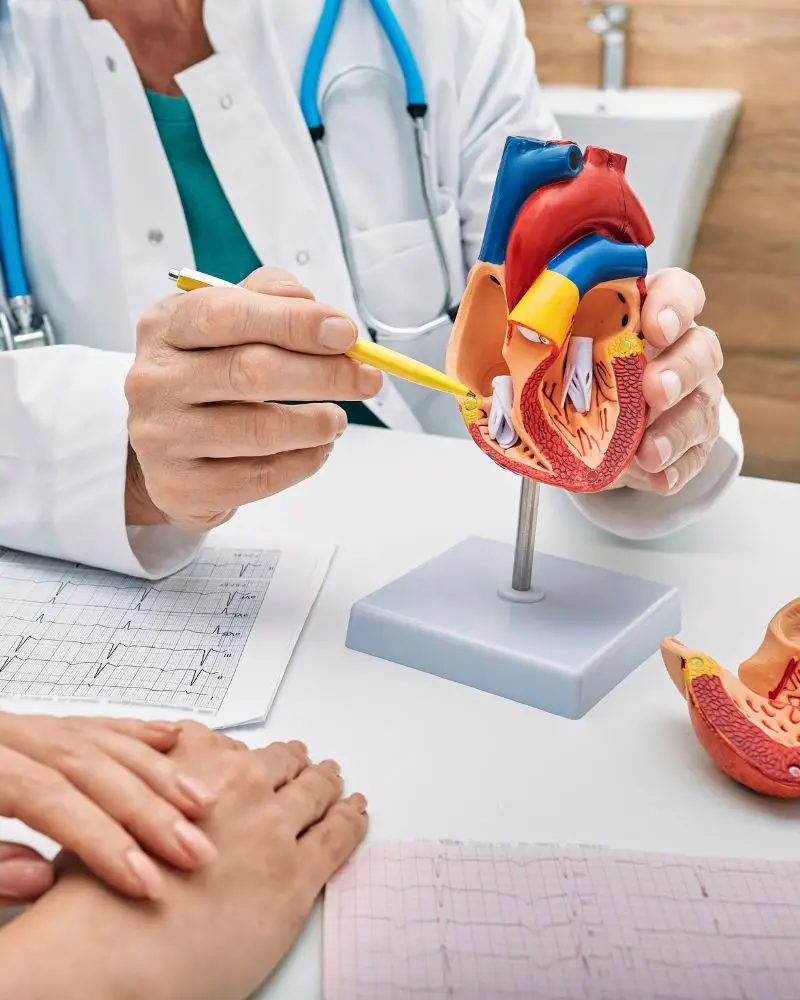



A stress test is interpreted, not simply scored. Our cardiologists review the whole recording alongside your symptoms and risk, and explain what the result does and does not establish.

General & Preventive Cardiology

Preventive & Non-Invasive Cardiology

Interventional & Vascular Cardiology
Treatment plans tailored to your symptoms, history, and individual needs.
Preventive, diagnostic, interventional, and vascular care in one practice.
Modern diagnostics for heart rhythm, function, structure, and blood flow.
Serving Pearland with additional locations expanding across Greater Houston.
Experienced physicians with advanced cardiovascular training and expertise.
We work with many leading insurance plans for convenient access to care.
Alliance Heart & Vascular is expanding to serve patients across Pearland, Greater Houston and surrounding communities.
Comprehensive cardiology, preventive cardiovascular care, diagnostic evaluation, and follow-up.
View Pearland LocationAlliance Heart & Vascular is expanding across Greater Houston and nearby communities, bringing convenient access to trusted cardiovascular care closer to where our patients live and work.
Alliance Heart & Vascular works with many major health insurance plans. Insurance participation can vary by plan, network, employer, and location.
Please call (346) 614-0002 before your appointment to verify your specific insurance benefits and network participation. Our team can help answer questions about scheduling, referrals, and insurance verification.
Stress testing is used when symptoms appear with exertion, or when coronary risk needs clarifying. Common reasons include:
How far you can walk, and what stops you, is itself diagnostic information. Exercise capacity is one of the strongest predictors of cardiovascular outcome we have.
Stress testing helps investigate several cardiovascular conditions. Learn more about:
Stress testing is a scheduled investigation. If you have chest pain at rest, severe breathlessness, or fainting, call 911 immediately rather than waiting for a test.
Do not wait for an office appointment.
Online appointment requests should never be used for potentially life-threatening symptoms.
The test produces several strands of information at once, and the combination is what makes it useful:
Reproducing your symptom during the test, and seeing what the heart does at that exact moment, is often more valuable than the EKG changes alone.
The whole appointment usually takes under an hour, with the exercise portion lasting roughly six to twelve minutes depending on your fitness.
Electrodes are placed and a resting EKG and blood pressure are recorded, giving a comparison point for everything that follows.
The treadmill speed and incline increase every three minutes in stages, raising the demand on the heart in a controlled and repeatable way.
Your EKG, heart rate, blood pressure, and symptoms are watched throughout by staff trained to stop the test the moment it is appropriate.
The aim is a target heart rate based on your age. Reaching it makes a normal result far more reassuring than stopping early.
Monitoring continues for several minutes after you stop, because some abnormalities appear only during recovery.
If you cannot walk on a treadmill, medication can be used to produce the same effect on the heart without exercise.
Preparation matters more here than for most cardiac tests, because several everyday things can affect the result:
Ask our office before holding any medication. Some, such as beta blockers, blunt the heart rate response and may need pausing — but never stop a cardiac medication without being told to.
Stress testing is aimed principally at coronary disease, but it also clarifies several other exertional problems.
The primary purpose. It identifies narrowing significant enough to limit blood flow when the heart is working hard. Read more about coronary artery disease.
Reproducing exertional chest discomfort under monitoring establishes whether it is cardiac in origin. Read more about chest pain.
Distinguishes breathlessness caused by limited cardiac reserve from other causes. Read more about shortness of breath.
Some rhythm disturbances appear only under exertion, and the treadmill is the reliable way to provoke and record them. Read more about arrhythmias.
An abnormal rise or fall in pressure during exercise carries prognostic meaning of its own. Read more about high blood pressure.
Not every patient needs every cardiac test. Testing should be selected based on your symptoms, examination, medical history, and cardiovascular risk. Depending on your individual situation, your cardiologist may recommend one or more of the following.
Measures the heart's electrical activity and may identify rhythm problems or other cardiac changes.
Uses ultrasound to evaluate heart function, chambers, valves, muscle, and structure.
Shows how the heart responds to physical activity and may help evaluate exercise-related symptoms.
Uses cardiac imaging during stress testing to assess blood flow to the heart muscle.
Records heart rhythm over time to help detect intermittent arrhythmias or palpitations.
Blood tests may evaluate cholesterol, blood sugar, kidney function, and other cardiovascular risk factors.
Certain patients may require additional cardiac imaging or coronary evaluation depending on their symptoms and risk profile. Your cardiologist will explain why a particular test is being recommended and how the results may influence your treatment plan.
Your cardiologist reviews the full recording rather than a single number, and interprets it against your symptoms and risk. Next steps may include:
An abnormal stress test is a reason for further assessment rather than an emergency in itself. It tells us the question is worth pursuing, not that treatment is inevitable.
An abnormal stress test is common and does not automatically mean a blockage needs treating. False positives occur, particularly in patients at low risk, which is why the result is always interpreted alongside your symptoms and risk profile rather than on its own.
An appointment is worthwhile if you have:
Talk to our office — Monday to Friday, 8:00 a.m. to 4:30 p.m.
Call (346) 614-0002Symptoms that only appear with effort need testing under effort.
Whether you have chest discomfort or breathlessness on exertion, an abnormal result elsewhere, or risk factors that need clarifying, we perform and interpret stress testing on site at both Houston locations.
New patients are welcome.
Serving patients throughout Pearland, Greater Houston, and surrounding areas.